Ouassima Oualkadi is an international journalism student with a focus on European Union politics and the Middle East. As a passionate beginner, she brings curiosity, determination, and a growing global perspective to her reporting. Ouassima is eager to expand her skills, explore complex political narratives, and contribute thoughtful, well-researched journalism to a wider audience.
President Volodymyr Zelensky warned of delays in funding, stressing that drone production would be reduced if support from EU and American partners were not received this spring.
According to RBC-Ukraine, during a meeting in Brussels Zelenskyy told the media that drone production is at risk if the spring funding is not received.
If in the spring Ukraine does not receive the appropriate tranche, which in the event of peace, Ukraine will use to restore our state, and in the event of the continuation of the war, Ukraine will use for the following priorities, primarily the production of drones, the production of drones in Ukraine will be reduced several times. states Zelensky.
This could sharply decrease the production of low-cost combat drones and endanger Ukrainian capabilities in the long term.
Given the current conditions, European Commission President Ursula von der Leyen proposed two options: a reparation loan at the expense of frozen Russian assets or joint borrowing based on the EU budget. She insisted a solution be reached by the Dec. 18–19 meeting.
However, Belgium opposed the first option, as it holds the largest share of Russian assets, and its position was backed by several European countries, including Hungary, Slovakia, and Italy.
European Commission President Ursula von der Leyen is pushing EU leaders to sharply raise defence spending in light of the security risks facing Europe.
In a letter to heads of state, she argues Europe must “be in charge of its own deterrence and defence,” warning that the current geopolitical climate is among the most fraught in decades.
Von der Leyen unveiled an ambitious plan to “ReArm Europe” which would cost around €150 billion in loans to member states to invest in key military capabilities like air/missile defence, artillery, drones, and anti‑drone systems. She also suggested redirecting EU budget funds towards defence and mobilising private capital.
According to the letter we could witness the beginning of the end of this conflict by the end of 2026. However Von der Leyden stressed being fully prepared for both continued war and long-term rebuilding.
“The scale of Ukraine’s financing deficit is significant. According to preliminary forecasts by the International Monetary Fund – provided that the war ends at the end of 2026 and taking into account all the support promised by the EU, member states and international partners – Ukraine will still face a huge shortfall that cannot be overcome without attracting new financing,” Von Der Leyen wrote to the EU leader
The plan is expected to be agreed on during the next European Council meeting, with von der Leyen urging immediate action.
Italy has joined Belgium in urging the EU to explore alternatives to using frozen Russian assets to fund Ukraine.
According to POLITICO, Italy has strongly backed Belgium’s opposition to the EU’s plan to use €210 billion of Russia’s frozen state assets to support Ukraine’s economy.
Other countries, such as Malta and Bulgaria, joined Belgium in criticising the European Commission’s efforts to finalise the plan ahead of the EU summit on Dec. 18–19.
They propose alternatives such as issuing joint EU debt or establishing loan facilities to fund Ukraine. They also voice scepticism about the Commission using emergency powers to extend the freeze and potentially seize assets.
However, issuing a joint EU debt could increase national debt for countries like Italy and France, and the measure would requireunanimity, giving countries like Hungary veto power.
Prime Minister Giorgia Meloni has repeatedly backed sanctions on Russia, while Deputy PM Matteo Salvini has taken a Russia-friendly stance and supports Donald Trump’s peace plan.Belgium warns it could be liable to repay Russia if Moscow successfully challenges the use of these frozen assets held at Euroclear in Brussels.
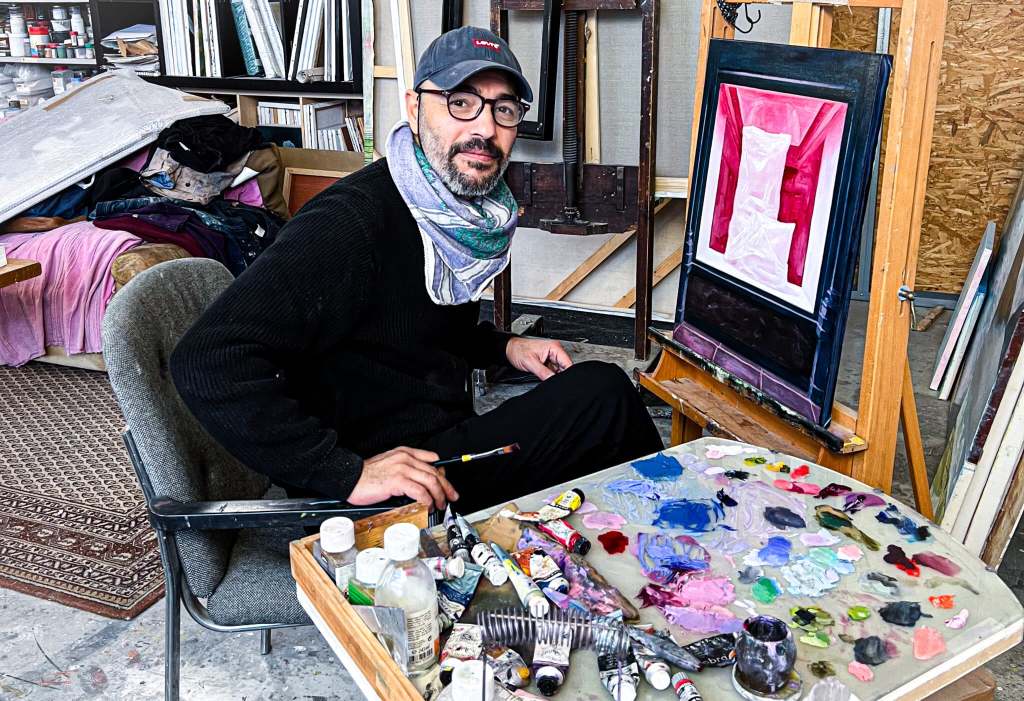
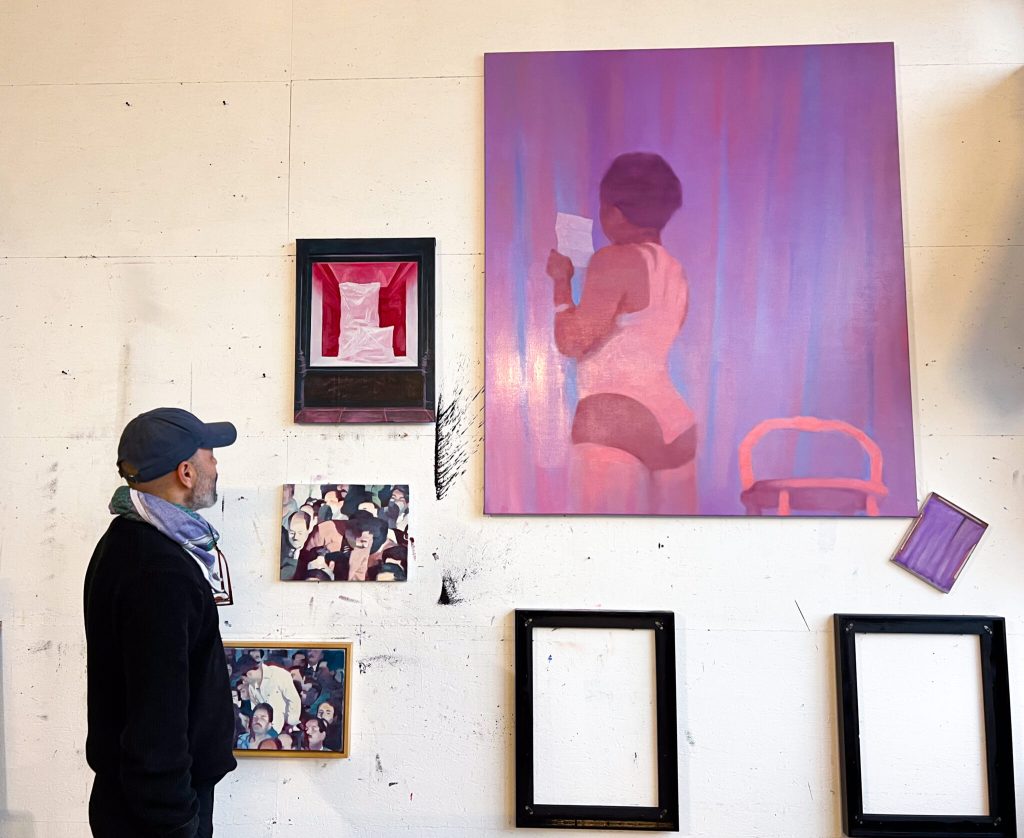
Hamdan Saray, a 49-year-old Iraqi painter born in Baghdad lives in Belgium now; he fled his homelandin 2003 after the American invasion of Iraq. He transformed the trauma of surviving three wars into a powerful artistic journey. He exhibits his artwork between Brussels and Baghdad.
Discovering art as a child
“I have always loved painting and drawing since childhood. I would often sketch my teachers and friends, who loved my work. I was fascinated by biographies of European and American artists, such as Mark Rothko and Luc Tuymans and found myself inspired by their lives and the ways they lived.”
“Later, I attended the College of Fine Arts at the University of Baghdad and graduated in 2003, but life always has other plans. As the American invasion of Iraq began, I moved to Belgium after a friend encouraged me to leave. I left, uncertain of where to go or what was waiting for me.”
Starting over in Belgium
“The experience of moving to Belgium was overwhelming. Everything felt strange and different: the language, the culture, the lifestyle. I had left behind a devastated city whose scars still showed on every street. My generation was often called the generation of wars because we had never known peace. Starting all over again in a foreign land, with no one to share my experiences, was so difficult.”
“Along with that, the art world here in Belgium was quite different from what I had known. I felt lost and disoriented. It felt almost like learning an alien language with new techniques, styles, and viewpoints. To integrate into this new society, I immersed myself in Belgian life, exploring its artistic traditions. This exploration became crucial for my artistic development.”
Using art to proces trauma
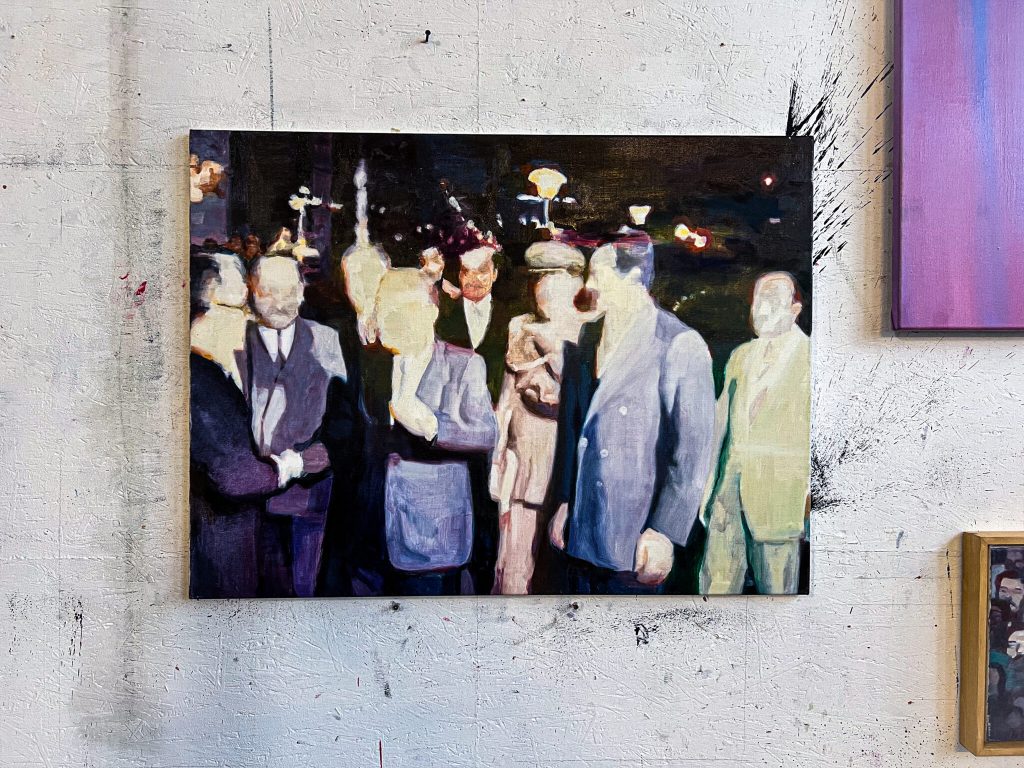
“Art is more than just painting, it’s a way of expressing what words can’t. I wanted to depict the lasting images of war and the propaganda that once dominated my homeland. I paint from my memories because I believe they shape the way we see the world.”
“Before I start a new piece, I watch clips from Lest We Forget, a TV show that features clips and images of the war in Iraq. I pick moments that speak to me and use them as inspiration. Translating those memories into paintings helps me process their weight. It’s my way of expressing my ideas and emotions and everything I’ve been through.”
“Many of my friends say that my paintings are too sad, dramatic, and heavy. But art is my tool of expression. As I always say, I am a son of war. I was only five years old when the war with Iran began. Then came the Gulf War, and then more conflicts after that. These experiences shaped me, and I have to talk about them through my art.”
Returning to painting as a form of healing
“There was a time when I stopped painting. There was too much bad news flowing to distract me from concern about my family back home. Finally, I figured out that not painting just made things worse.”
“Returning to art became a watershed moment in my life, allowing me to process grief, fear, and uncertainty. I can honestly say that art has been my greatest tool for healing.
Art cannot always be joyful and colourful; it’s also a way of showing the horror in this world.” Hamdan Saray
I want people to understand that art isn’t just about bright colours and happy images. It’s also about pain, struggle, and truth. Each painting tells a story, and I hope people take the time to really contemplate each piece. Some paintings are bold and attractive, catching attention very fast, and some are shy and quiet. Just like people—you need to take the
 Home
Home 